3 Habits That Fix Your Transfers: FPL Psychology for Better Decisions

FPL psychology is about recognising the predictable ways your brain steers transfers, captaincy and chip use, then using rules to undo them. Skill is doing far more work than luck in this game, according to a large-scale skill analysis, which means most of your mistakes aren't bad luck. They're outcome bias, anchoring and endowment effect talking you into decisions you'll regret by Saturday.
TL;DR:
- Most FPL mistakes stem from cognitive biases such as outcome bias, confirmation bias, and anchoring, which distort decision-making before kickoff.
- Using a structured checklist for transfers and setting fixed decision times can significantly reduce bias-driven errors and impulsive reactions.
- Social media pressure and limited data visibility often increase anxiety; managing your feed and schedule helps keep focus on rational analysis.
- The biggest game-day errors often come from emotional decisions, such as overvaluing players in your squad or chasing short-term streaks without proper reasoning.
- Tools that provide real-time updates and stats can lower stress, improve league enjoyment, and prevent obsessive checking and rank obsessing.
Table of Contents
- The key cognitive biases that affect FPL decisions
- How those biases show up in common FPL behaviours and mistakes
- Practical decision protocols: rules, checklists and timing to reduce bias
- Managing social media, FoMO and mini-league pressure
- When FPL stops being fun: recognising stress and where to get help
- How mini-league tools can make your league less stressful and more enjoyable
- What I've learned from three seasons of overthinking transfers
- Want less stress and more banter in your mini-league?
- Sources
- FAQ
The key cognitive biases that affect FPL decisions
I used to think my rank swung on VAR decisions and 89th-minute penalties. Turns out most of the damage happened in my own head, days before kick-off.
Outcome bias is the big one. You judge a decision by what happened, not by whether it was sound when you made it. Bench Haaland, he blanks, you feel vindicated. Bench him again next week using the same reasoning and he scores twice. The decision process didn't change, only chance did. This is exactly the trap described in the outcome bias primer from the Interaction Design Foundation: people mislearn from results instead of from the quality of the reasoning that produced them.
Confirmation bias shows up whenever you've already decided to buy a player and start hunting for reasons to justify it. Suddenly every underlying stat looks glowing and every red flag looks like noise.
Anchoring, primacy and recency all distort how you weigh information over time. You anchor to a player's price when you first noticed him, you overweight his pre-season hype (primacy) or his last two performances (recency), and you ignore the messier middle of the season that tells the fuller story.
The endowment effect makes you overvalue players already in your squad. You paid a transfer, you've watched them all campaign, so you cling on past the point the data says you should sell.
Then there's overconfidence paired with a gambler's fallacy cousin: after three good gameweeks you start believing you've cracked the code, and after three bad ones you start believing a big rank swing is "due".
One thing to hold onto through all of this: performance is mostly persistent skill, not streaks of fortune. A large-scale analysis of FPL managers found that the vast majority of season-to-season variance in rank comes from persistent skill, with a smaller fraction attributable to within-season noise. Your process matters more than any single result.
Quick recognition cues, so you can catch yourself mid-decision:
- Outcome bias: you're grading a past decision by the scoreline, not the logic.
- Confirmation bias: you're only clicking stats that back a transfer you've already mentally made.
- Anchoring: you're comparing a player's price or form to a moment from weeks ago, not now.
- Endowment effect: you're finding excuses to keep a player everyone else has moved on from.
- Overconfidence: you're convinced your last three gameweeks prove a pattern, not a run.
How those biases show up in common FPL behaviours and mistakes
Biases don't stay in your head. They turn into actual clicks on the transfer screen, and those clicks cost points.
Template teams are the clearest case. When the same five or six players sit in most top squads, that's often not blind herding, it's convergence on genuinely strong choices that skilled managers have independently arrived at. Following the template protects your rank against the field. It punishes you the moment you copy it out of anxiety rather than analysis, because you end up owning players you haven't actually vetted against your own squad's needs.
Transfer hits run on faulty mental math. A four-point hit feels small in isolation, so managers talk themselves into it gameweek after gameweek, forgetting that four points is roughly the return of a decent bench player doing nothing. The bias here is treating each hit as a standalone bet rather than a running tab.
Chip hoarding is fear dressed up as patience. Managers sit on the Bench Boost or Triple Captain waiting for a "perfect" gameweek that never quite arrives, while the opportunity cost of not using it stacks up silently. The flip side, burning a chip the moment a marginally good week appears, is the same fear working in the opposite direction: use-it-or-lose-it panic instead of considered patience.
Captaincy swings are outcome bias in real time. Pick the safe captain, he blanks, and the next week you overcorrect into a risky differential purely because the "safe" option let you down once. Differential-chasing after a bad week is rarely about new information, it's about needing to feel like you're doing something different.
A quick composite case: a manager captains their in-form striker for six straight weeks, he returns four times, then blanks once against a tough away fixture. The manager benches him the following week out of frustration. He scores twice. That's not bad luck stacking up, that's one outcome-biased decision undone by another.
Spotting these patterns in your own history:
- Template panic: joining the crowd without checking the pick fits your squad's fixtures and gaps.
- Hit creep: taking a hit because "it's only four points" three weeks running.
- Chip paralysis: still holding a chip in gameweek 30 because no week has felt perfect enough.
- Captaincy whiplash: switching captains the week after a rare blank rather than sticking with the underlying logic.
Practical decision protocols: rules, checklists and timing to reduce bias
None of this matters unless you turn it into something you actually do each gameweek. Rules beat willpower, mainly because willpower runs out by Friday night.
Start with when you decide, not just what you decide. Fatigue and poor sleep push people towards riskier, less considered choices, and Harvard Health's guidance on sleep strategies points to better rest supporting clearer thinking generally. Practically, that means making transfers and captaincy calls in a morning window, not at midnight after doomscrolling through fifteen differential threads. Set a hard deadline for yourself, say Saturday morning, and treat anything decided after that as suspect.
A weighted checklist turns a vague "gut feeling" transfer into something you can actually defend later, win or lose:
- Fixtures: are the next three to five games genuinely favourable, not just "not terrible"?
- Minutes: is the player a guaranteed starter, or are you gambling on rotation risk?
- Ownership: does bringing this player in change your rank risk in a way you're comfortable with?
- Form: is the underlying performance data trending up, or is one big haul carrying the whole case?
- Injury risk: has the player picked up a knock, or is there a return-from-injury pattern that history says to be wary of?
Score each factor loosely, out of five, and only make the move if the total clears a threshold you set in advance. This is the same logic used in transfer-selection guides built specifically to slow down snap decisions.
Build in a default action too: if nothing on your checklist clears the bar, the default is no transfer. Doing nothing is a legitimate decision, not a failure to act. Pair that with a veto window, a rule that any transfer decided in a flash of frustration (straight after a blank, straight after seeing a rival's rise) has to sit for at least twelve hours before you confirm it.

Chips deserve a calendar, not a vibe. Mark out rough windows across the season (double gameweeks, favourable runs, cup-final weekends for rivals) and commit to using each chip within its window unless there's a specific, written reason not to. The opportunity cost of holding a chip too long is real: every week you don't use the Bench Boost during a double gameweek is points left on the table that a fixed calendar would have captured.
Pro tip: Write down your reasoning for a transfer before you make it, in one line. If the result goes badly, read that line back before you change anything, because it stops a single fluke result rewriting your whole strategy.
Managing social media, FoMO and mini-league pressure
Social media doesn't just inform your FPL decisions, it can quietly wind up your anxiety about them. Primary-care research on social media's effect on anxiety notes it as a meaningful factor worth addressing in clinical conversations, and fantasy football feeds run on the same mechanics: constant comparison, curated highlight reels and a sense that everyone else made the smarter call.
A few boundaries go a long way:
- Curate your timeline so it's mostly analysis accounts, not rank-shaming rivals.
- Schedule check-ins, say once in the morning and once after full-time, rather than refreshing all day.
- Avoid transfer polls, which just crowdsource anchoring bias with extra peer pressure.
- Mute trending hashtags around a single "must-have" player until you've done your own checklist.
Tracking rivals is part of the fun of a mini-league, but there's a right way to do it that keeps banter sharp without keeping you up at night, covered in more depth in this guide to following FPL rivals properly.
Pro tip: When a viral "must-transfer-in" narrative hits your feed, wait 24 hours, verify it against your own checklist, then decide, because the noise is loudest right before the price rise, not right before the returns.
When FPL stops being fun: recognising stress and where to get help
FPL is meant to be banter with your mates, not a source of dread. If it's tipping into the second category, that's worth taking seriously rather than shrugging off as "just a game".
Watch for these signs in yourself:
- Checking rank obsessively, multiple times an hour, even outside match time.
- Mood swings tied to gameweek results that spill into your actual day.
- Losing sleep over a transfer decision or a rival's rise.
- Avoiding your mini-league chat because it's become a source of dread rather than fun.
If any of that sounds familiar and persistent, it's worth knowing that NICE guidance on social anxiety recommends cognitive behavioural therapy as a first-line psychological treatment, delivered individually with structured sessions. A GP referral is the usual route in, and CBT works by helping you challenge the specific thought patterns driving the distress, not by telling you to simply stop caring.
In the meantime, small coping steps help: protect your sleep, cut your rank-checking down to fixed windows, and if a particular gameweek has you rattled, give yourself permission to step away from the app entirely for a day or two. The league will still be there.
How mini-league tools can make your league less stressful and more enjoyable
A lot of the anxiety in the last section comes from uncertainty: not knowing your rank, your bonus points or whether your auto-subs kicked in until the official update finally lands hours later. Resolving that uncertainty faster genuinely reduces the urge to keep checking.
That's the specific gap FPL.fun fills for mini-league admins and managers:
- Instant standings update as bonus points and auto-subs are confirmed, so you're not refreshing a spreadsheet by hand.
- Weekly awards and shareable charts channel rivalry into banter rather than silent rank anxiety.
- Historical archives let a league look back at the season's story instead of obsessing purely on the current table.
If you manage a mini-league, the live standings page is a low-effort way to see the difference.
What I've learned from three seasons of overthinking transfers
A few seasons back I benched a player after one bad week, on gut feel, no checklist, nothing written down. He scored twice against the side I'd swapped him for. That's when the checklist idea actually stuck, not as theory but as a way to stop that exact regret repeating.
Three habits changed my season more than any single transfer ever did: decide in the morning, run the checklist before confirming anything, and check social media on a schedule rather than a compulsion. None of it guarantees a green arrow.
Treat FPL as a learning system. Track your decisions, not your ego, and the rank tends to follow.
— Przemek
Want less stress and more banter in your mini-league?
Stop chasing overall rank and get back to pure banter, joy and fun with your mates, and let the app carry the admin. Standard FPL updates leave you refreshing pages for hours after full-time, wondering if that auto-sub actually triggered. FPL.fun shows instant standings, live bonus points and auto-sub tracking as matches unfold, plus quirky weekly awards that turn rivalry into laughs instead of dread.
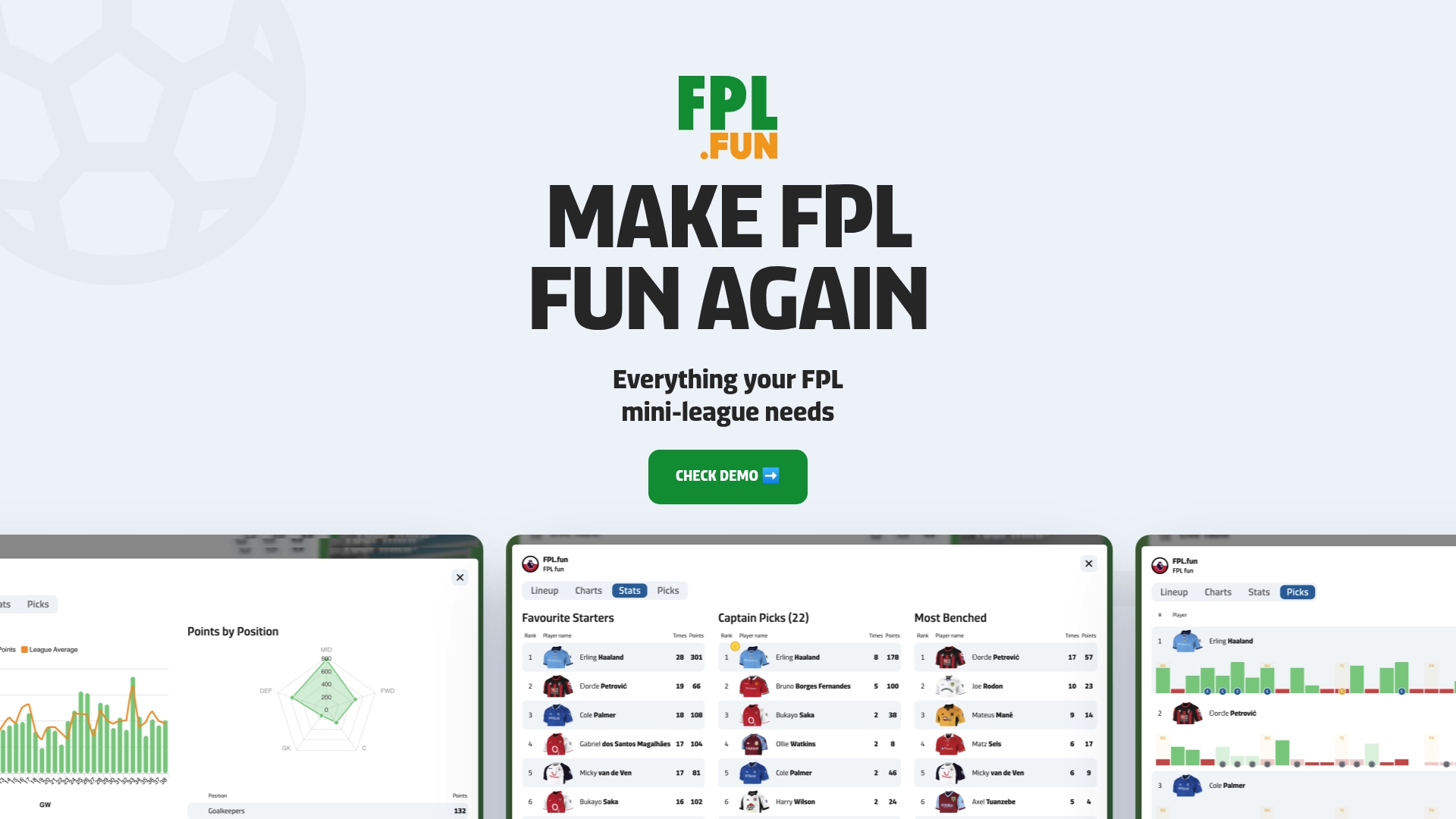
Individual Access and League Access plans are available on FPL.fun, with current prices listed on the pricing page. Check your league's live table now on the live standings page, or see how it fits your group with the Fantasy Premier League tutorial.
Sources
- Identification of skill in an online game: The case of Fantasy Premier League | PLOS One
- Social anxiety disorder: recognition, assessment and treatment | NICE
- Exploring the facilitators and barriers to addressing social media’s impact on anxiety within primary care | BJGP Open
- Strategies to promote better sleep | Harvard Health
- Outcome bias primer | Interaction Design Foundation
FAQ
What does FPL stand for?
FPL stands for Fantasy Premier League, the official fantasy football game run alongside the Premier League. Players build a squad of real footballers and score points based on those players' actual match performances.
What actually is FPL?
FPL is a season-long game where you manage a virtual squad within a budget, picking a starting eleven each gameweek and earning points for goals, assists, clean sheets and other in-game actions. You can find a fuller breakdown of the basics in this introduction to what FPL is all about.
Is FPL skill or luck?
FPL is mostly skill. A large-scale analysis of manager performance found that most season-to-season variance in rank comes from persistent skill, with a smaller fraction attributable to within-season luck.
What does FPL form mean?
FPL form usually refers to a player's recent scoring output over their last few gameweeks, used as a signal for transfers and captaincy. It's a useful indicator but prone to recency bias, so it works best alongside fixtures, minutes and underlying stats rather than on its own.